C
o
m
m
e
n
t
a
r
y
From Albert Barnes Commentary...
The expression I am, though in the present tense, is clearly designed to refer to a past time. Thus, in Psa_90:2, “From everlasting to everlasting thou art God.” Applied to God, it denotes continued existence without respect to time, so far as he is concerned. We divide time into the past, the present, and the future. The expression, applied to God, denotes that he does not measure his existence in this manner, but that the word by which we express the present denotes his continued and unchanging existence. Hence, he assumes it as his name, “I AM,” and “I AM that I AM,” Exo_3:14. Compare Isa_44:6; Isa_47:8. There is a remarkable similarity between the expression employed by Jesus in this place and that used in Exodus to denote the name of God. The manner in which Jesus used it would strikingly suggest the application of the same language to God. The question here was about his pre-existence. The objection of the Jews was that he was not 50 years old, and could not, therefore, have seen Abraham. Jesus replied to that that he existed before Abraham. As in his human nature he was not yet 50 years old, and could not, as a man, have existed before Abraham, this declaration must be referred to another nature; and the passage proves that, while he was a man, he was also endowed with another nature existing before Abraham, and to which he applied the term (familiar to the Jews as expressive of the existence of God) I AM; and this declaration corresponds to the affirmation of John, that he was in the beginning with God, and was God. This affirmation of Jesus is one of the proofs on which John relies to prove that he was the Messiah, to establish which was the design of writing this book (Barnes).
r
a
m
m
a
t
i
c
a
l
A
n
a
l
y
s
i
s
PRIN ABRAAM GENESTHAI EGÔ EIMI
Before Abraham came to be, I am
GINOMAI (G1096)
To become, i.e. to come into existence, begin to be, receive being (Thayer).
EIMI (G1510)
To be, to exist, to happen, to be present (Thayer).
I am (egw eimi). Undoubtedly here Jesus claims eternal existence with the absolute phrase used of God. The contrast between genesthai (entrance into existence of Abraham) and eimi (timeless being) is complete. See the same contrast between en in John 1:1 and egeneto in John 1:14. See the contrast also in Psa 90:2 between God (ei, art) and the mountains (genesthenai). See the same use of eimi in John 6:20; John 9:9; John 8:24, John 8:28; John 18:6 (RWP).
U
R
T
H
E
R
R
E
A
D
I
N
G
It seems the WT will go to any lengths to make sure Jesus does not identify Himself as ego eimi.
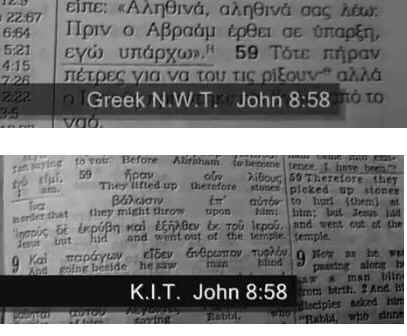
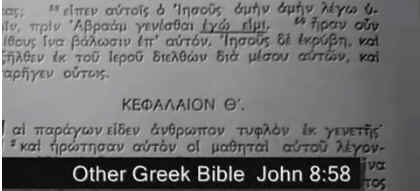
Vamvas Modern Greek NT (1850):

*I am indebted to 4Jehovah.org for this information
Articles...
John 8:58: How Do We Translate? Kelton Graham
I Am What I Am JP Holding
The Gospel Truth about John 8:58 Arthur Daniels
Dialogs...
Jason BeDuhn and Robert Bowman
Jason BeDuhn and Robert Hommel (follow up to above)
Blogs...
